The Science of Design Is Medicine™
Explore the scientific research behind Design Is Medicine™. Learn how neuroaesthetics, circadian biology, biophilia, and meaning influence health, resilience, recovery in our built environment.
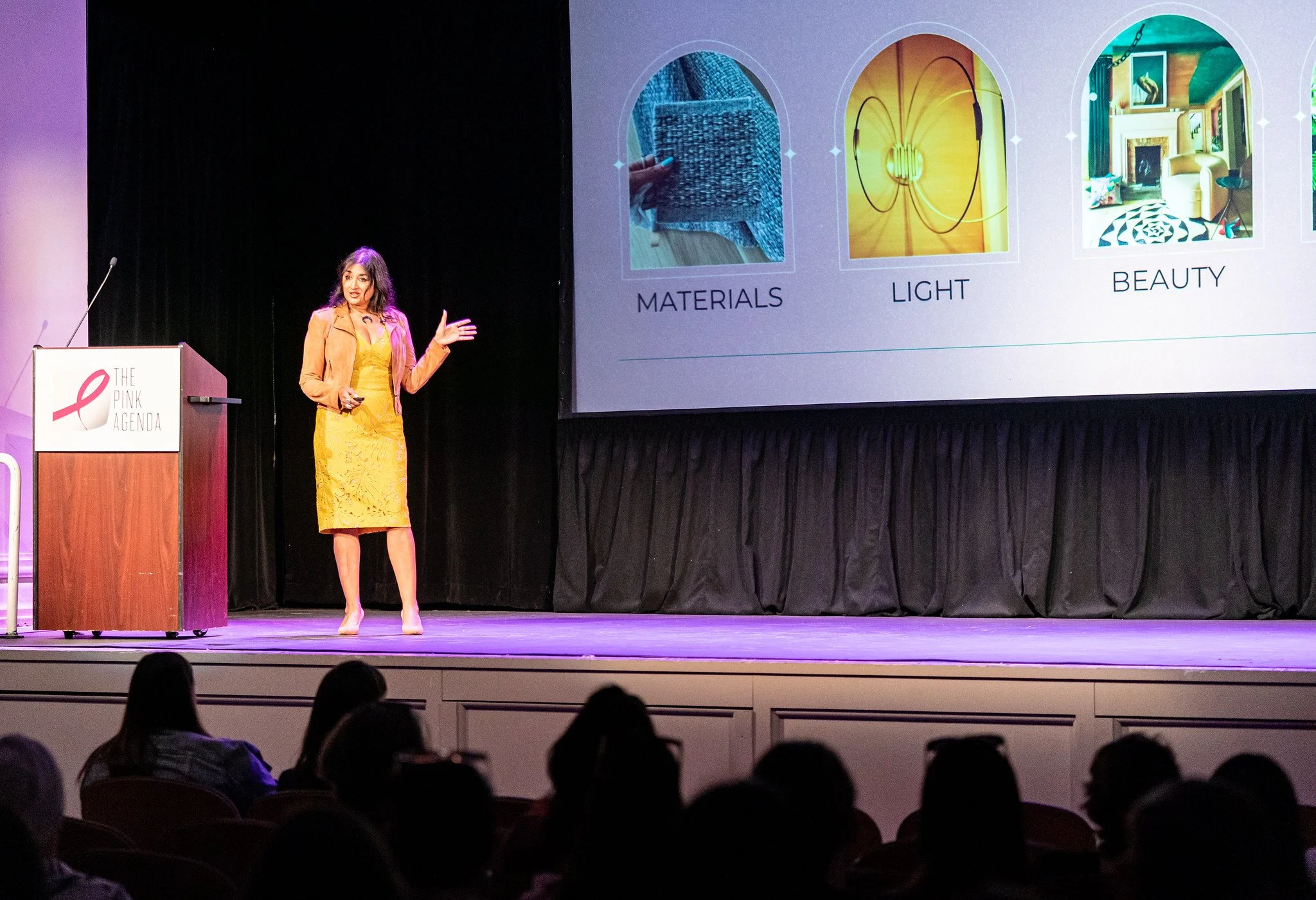
Why Design Is Medicine™
Design Is Medicine™ brings together four complementary bodies of evidence.
Three explain how our environments influence biology.
The fourth explains why those environments become deeply personal.
Together, they reveal that our surroundings are not passive backdrops, but active participants in our health and our identity.
Our Indoor Existence
We spend approximately 90% of our lives indoors, yet environment remains one of the least discussed influences on health. Design Is Medicine™ explores the growing body of research demonstrating that light, beauty, nature, sensory experience, and the built environment influence stress physiology, cognition, emotion, recovery, and overall health.
Explore the Research
1. Neuroaesthetics
Beauty isn't superficial. It is biological.
The brain constantly evaluates color, proportion, texture, sound, scent, novelty, familiarity, symbolism, and emotional associations. These sensory experiences influence attention, stress physiology, emotional regulation, and resilience.
Research explores how aesthetic experiences affect the nervous system, reward pathways, memory, and emotional processing.
Beauty Regulates the Nervous System
For centuries, beauty has been treated as decoration. Emerging research suggests something very different: aesthetic experiences influence how our brains regulate attention, emotion, and stress.
Researchers Susan Magsamen and Ivy Ross describe beauty as a biological experience—one that activates multiple neural systems simultaneously rather than existing outside of health.
Rather than treating beauty as an afterthought, this research invites us to consider beauty as part of the conditions that support our well-being.
The Brain Was Designed to Seek Beauty
Neuroscientist Dr. Anjan Chatterjee argues that our attraction to beauty isn't accidental—it is rooted in evolution. Our brains actively construct aesthetic experience, linking beauty with attention, memory, reward, and meaning.
Rather than asking whether beauty matters, his work explores why our brains are wired to seek it.
Design Is Medicine™ begins with this question: if our brains evolved to seek beauty, what happens when the environments we inhabit either nourish—or neglect—that relationship?
Field Notes
"When Beauty Was the Car I Drove"
"Healing Environments: Why Design Is Medicine™"
2. Circadian Alignment
Light is our oldest medicine.
Your body evolved under sunrise and sunset—not LEDs.
Circadian biology explains how light influences nearly every system in the body.
How Architecture Shapes Our Biological Clock
Emerging research suggests that buildings do far more than shelter us—they shape how our circadian system receives its most important biological signal: light.
A recent review examining architecture, daylight, and circadian biology concludes that the design of our homes, workplaces, hospitals, and schools directly influences the light exposures that regulate sleep, hormones, metabolism, mood, and long-term health.
The authors argue that healthy buildings should support what they call a healthy "spectral diet"—bright natural light during the day and darkness at night—rather than the constant exposure to artificial light that has become commonplace in modern life.
The idea isn't new. Florence Nightingale observed more than 150 years ago that patients in sunlit hospital rooms recovered with better spirits than those kept in darker spaces, leading her to advocate for hospital design that maximized natural daylight.
If architecture shapes how our bodies experience light, then design becomes more than aesthetics—it becomes part of our biology.
Modern Life Has Changed Our Relationship with Light
Our biology evolved beneath the rising and setting sun. Yet modern life increasingly surrounds us with artificial light long after sunset while keeping us indoors during daylight hours.
Researchers at Harvard Medical School describe circadian disruption as a growing public health concern. When light, meals, exercise, and sleep occur at conflicting times, the body's internal clocks begin operating on different schedules—what researcher Frank Scheer describes as one clock being "in Boston while another runs on Paris time."
This biological misalignment has been associated with metabolic dysfunction, elevated cortisol, impaired glucose regulation, obesity, cardiovascular disease, and poor sleep.
If our biology evolved in rhythm with the sun, shouldn't the spaces we inhabit support that rhythm rather than disrupt it?
Circadian Disruption and Cancer
Emerging research suggests that chronic disruption of circadian rhythms may also influence cancer biology. A recent review found that artificial light at night, shift work, and disrupted sleep patterns alter cortisol and melatonin regulation, creating biological conditions associated with inflammation, immune dysfunction, and tumor development.
Rather than viewing sleep as passive rest, circadian biology increasingly recognizes light as one of our body's primary biological signals.
For me, this research became deeply personal. It reinforced a question that continues to shape Design Is Medicine™: if light can influence the biology of disease, shouldn't the environments where we spend most of our lives be designed with that biology in mind?
3. Biophilia
Stephen Kellert: The Pioneer of Biophilic Design
Yale social ecologist Stephen Kellert, widely regarded as the father of modern biophilic design, argued that humans did not evolve apart from nature—we evolved within it. His work demonstrated that our connection to the natural world is not simply aesthetic; it is fundamental to our biology, health, and psychological well-being.
Rather than treating nature as decoration, Kellert proposed that the most restorative environments actively strengthen our relationship with the living world.
These ideas form one of the foundations of Design Is Medicine™, helping explain why light, living systems, natural materials, water, and views of nature influence stress, attention, recovery, and resilience.
Explore Stephen Kellert's framework →
Biophilic Design Works
Recent research continues to support what Kellert first proposed. A 2026 review found that incorporating natural light, vegetation, organic materials, water, and other biophilic elements into the built environment is consistently associated with lower stress, improved cognitive performance, better emotional well-being, and healthier indoor environments.
Rather than viewing nature as an amenity, this growing body of evidence suggests it functions as an active component of human health.
At Design Is Medicine™, biophilia is understood not as bringing nature indoors, but as restoring the biological relationship humans evolved to have with the natural world.
Nature Supports Recovery
One of the earliest and most influential studies on healing environments was conducted by environmental psychologist Roger Ulrich. He discovered that patients recovering from gallbladder surgery whose hospital rooms overlooked trees recovered more quickly, required less pain medication, and received fewer negative nursing evaluations than patients whose windows faced a brick wall.
The study helped shift the conversation from viewing nature as decoration to recognizing it as an active contributor to healing—an idea that continues to shape hospitals, healthcare environments, and biophilic design today.
Healing environments don't begin with decoration. They begin with understanding that our relationship with nature influences how we recover.
The Soul of Design Is Medicine™
4. Meaning & Identity
Meaning may be invisible, but its physiological effects are not.
Science tells us how environments influence biology.
Meaning explains why.
Design Is Medicine™ doesn't simply ask whether a room is healthy.
It asks how it reflects who you are.
Because we don't form relationships only with other people.
We form relationships with places, with inherited objects, with family traditions, with talismans, with memories, and with beauty.
Anthropology, psychology, narrative medicine, and environmental psychology all suggest that identity is continually shaped through the environments we inhabit.
The objects surrounding us become extensions of our identity.
The rituals we repeat become behavioral anchors.
The symbols we choose become stories our nervous system learns to trust.
This is why two identical rooms can feel entirely different.
One contains furniture.
The other contains meaning.
We don't simply respond to physical environments. We respond to what those environments mean.
Field Notes
Beyond the Research
Science explains the biology but the people who've experienced Design Is Medicine™ reveal what happens next. → Read In Their Words
The Practice of Design Is Medicine™
Design Is Medicine™ is an evolving body of work.
As new research emerges, this library will continue to grow. Because our understanding of how environment influences health is still unfolding.
When you're ready to move beyond the science and into practice: