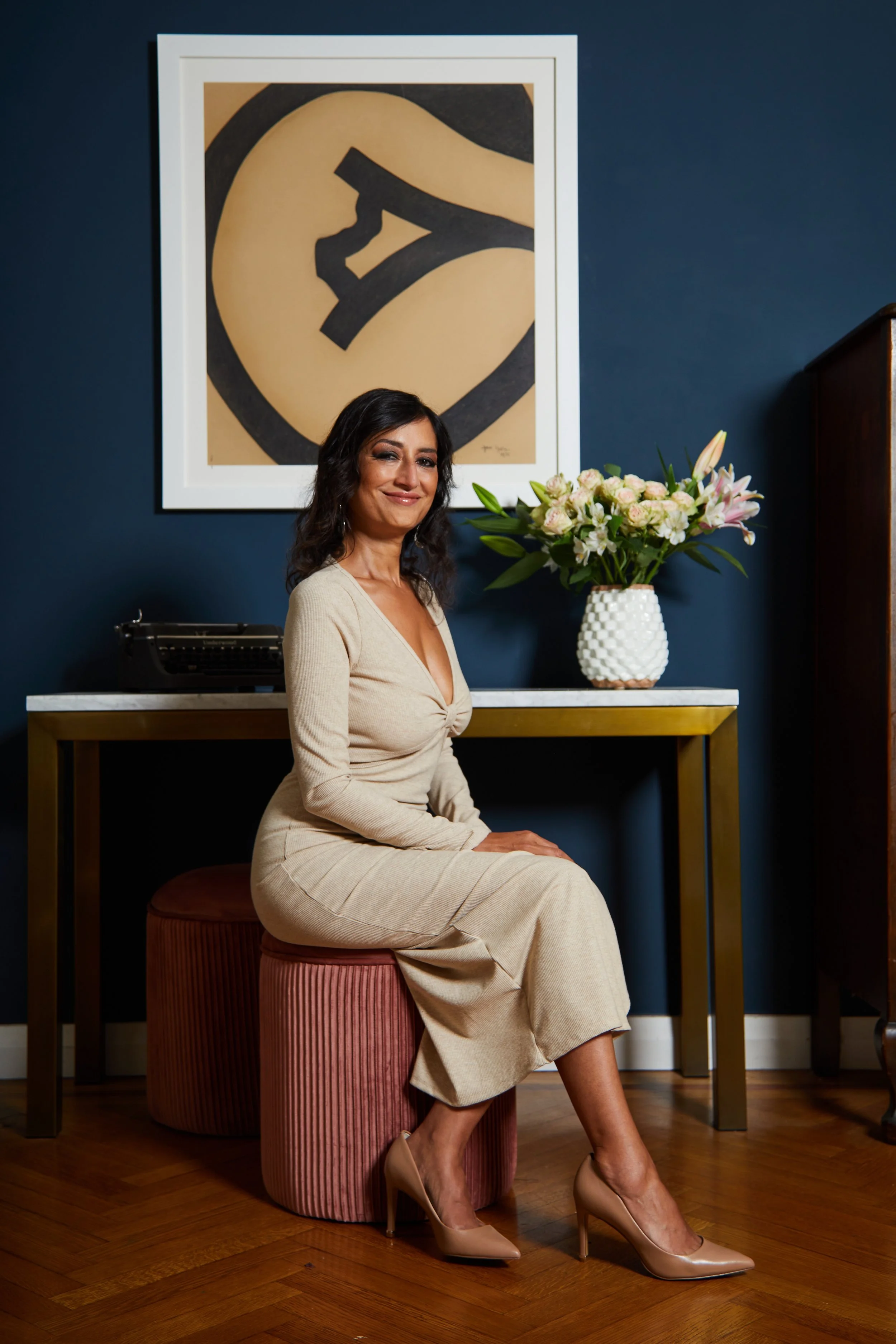
What if I told you that the way to healing isn’t just medicine. What if beauty is, as well? For more than twenty years, I’ve designed beautiful interiors and fashion for other people, but it wasn't until cancer that I began to question its meaning.
Because cancer didn’t only change my body. It untethered my mind. I began living in that liminal space between the person I used to be, and the one I didn’t yet know I’d become. I was suspended—not sick enough to completely disappear, not well enough to stay as I used to be.
I felt completely out of control. I couldn’t control my diagnosis. I couldn’t control the treatment protocol. But what I could control was how I moved through that limbo, that uncertainty. So I stopped searching for certainty.
I reached for beauty instead.
How Beauty Became My Practice
It started with not being able to taste the spicy Pakistani dishes that my mother lovingly prepared during my chemo. The spices suddenly overwhelmed me. What I could tolerate was a humble sliced banana. So, I dusted off my best dishes. I plucked violas from my garden, and decorated those meager medallions with something beautiful. I unfolded my best linen napkins, lit that candle—a birthday gift I was saving for a special occasion, and poured my water into my crystal wine glass. If I couldn’t taste, I could at least heighten my other senses to create a beautiful experience.
I played my favorite EDM while lying on the radiation table, reminding me of that version of myself speeding to biology class blaring Nine Inch Nails in my white Mazda. I loved that version of myself, where life felt full of possibility and hope just happened to be the air I breathed.
Little by little, beauty stopped being something I created for others. It became a powerful reminder of who I still was. When the reflection in the mirror looked nothing like the woman I once knew, I taped a photograph of myself at fifteen on the mirror above my bedroom dresser—a glimpse of a girl beaming with laughter in her olive combat boots and oversized army jacket draped over a grey pin-striped pencil skirt at the end of the driveway. She was a talisman—a symbol of innocence, love, and hope that still existed in me, even if my swollen face with the disappearing eyebrows and falling hair couldn’t show it.
I dressed myself up for the twelve-hour chemotherapy sessions at the hospital, adorning myself with my late grandmother’s jewelry. I wrapped my neck in a silk scarf from an aunt who loved more fiercely than anyone I’d ever known, dabbing lavender essential oil on the corners of it to remind me of a visit to a glorious, sun-drenched lavender field in California’s Santa Ynez Valley.
Scent is the fastest way to time travel, you know. I wasn’t ignoring what was happening or trying to escape it. I was choosing beauty in the face of sheer terror.
Especially then.
I Didn't Wait to Heal Before I Felt Beautiful
“I didn’t wait to heal in order to feel beautiful. I felt beautiful in order to heal.” I wrote those words years ago in Purgatory to Paradise.
We’re taught that beauty is an outcome—something we earn after we heal, after we can afford that renovation or work of art. But cancer taught me the opposite.
Beauty wasn’t my destination.
It was my vehicle to healing.
The Art That Waited for Me
Ten years before my diagnosis, I was sourcing artwork for a client in a gallery on Madison Avenue when I came across a charcoal drawing that took my breath away. It was of a woman, her body delineated by a bold calligraphic line against sepia paper, reminding me of the sinuous lines of Urdu and Arabic script I practiced writing as a little girl in Pakistan. The artist had distilled the divine feminine with such bold spareness that it was both an homage to 7th century Kufic Arabic as well as 18th century Japanese artist, Katsushika Hokusai’s, woodblock prints. At that time, I didn’t even consider bringing it home. That kind of art belonged to other people—not me.
Cancer changed that.
It didn't simply change my perspective on life—it changed my understanding of what I deserved to live with. Cancer emboldened me to break out of the waiting room of life, and actively seek beauty. Bringing that drawing home all those years later became an act of choosing life today, despite the uncertainty of tomorrow. I didn't buy it because I could finally afford it, I acquired it because I had a new perspective. Cancer taught me that I was worthy of living with beauty in my now.
When Science Finally Caught Up
At the time, I believed this sensory practice which I named my “Rituals of Reverence,” was simply personal. I discovered later that it was a part of something much larger. Researchers like Susan Magsamen and Anjan Chatterjee were asking many of the same questions I had lived firsthand.
How do beauty, art, and our sensory environments shape the brain? Could aesthetic experiences influence stress, attention, emotion, and well-being? The science didn't create my experience—it helped me to understand it.
Susan Magsamen and Ivy Ross explained in their seminal book, Your Brain on Art: How the Arts Transform Us, what I was instinctively doing: “the arts offer us a way to slow down, feel our emotional pain, and let it unfold, revealing a changed but full human being.”
Beauty wasn't distracting me from illness.
It allowed me to grieve my old identity, cope with the rigors of treatment, and alchemize my pain. I didn't know it then, but I was instinctively regulating my nervous system through my senses. I was anchoring into my parasympathetic state.
Dr. Anjan Chatterjee wrote in The Aesthetic Brain: How We Evolve to Desire Beauty and Enjoy Art that our brains are active participants in how we perceive and connect with the world, and that surrounding ourselves with beauty shapes who we become.
That charcoal drawing now hangs in my home and I gaze upon her every day. She became my Persephone—the goddess who journeyed into the Underworld and emerged transformed.
And in the words of Dr. Chatterjee, that divine symbol has shaped the woman I have become today.
Beauty Is Something We Practice
I used to think beauty was something designers created. Now I see it so very differently.
Beauty is something we practice.
You don’t need to buy an expensive piece of art to practice beauty. Begin where you are.
Open your curtains to let that sunlight inside. Notice how that morning light glows against your bedcover. Place a bud vase with a single stem of a flower you love—a rose, a sunflower, or a dahlia from your garden. Use your wedding china now. Light that expensive candle today—don’t wait for a special occasion. Make today special. Play your favorite songs as a reminder of a great concert you went to or just a moment of innocence. Engage every single one of your senses to create beauty no matter what is happening in your life.
Beauty is not an object. It is a daily conversation between your senses and your brain, between your identity now and the one that is arriving.
Beauty Was Never the Destination
I used to believe beauty was the destination—the finished room or the impeccably designed dress.
Cancer taught me it was the vehicle.
I didn't wait to heal before I felt beautiful.
I felt beautiful so that I could heal.
Because beauty isn't the reward for healing.
It's how we heal.
About Field Notes
Field Notes is an ongoing series exploring beauty, neuroaesthetics, biology, culture, and the built environment through the lens of Design Is Medicine™.
Continue the Conversation
If this Field Note resonated with you, I'd love to hear your thoughts. Questions, collaborations, or speaking inquiries are always welcome.
Enjoyed this Field Note?
Subscribe to the Design Is Medicine™ newsletter on LinkedIn for new essays, observations, and research exploring beauty, biology, and the built environment.
Research & Reading
Syed, Mahwish. Purgatory to Paradise: How Cancer Helped Me Design an Authentic Life.
Magsamen, Susan & Ross, Ivy. Your Brain on Art: How the Arts Transform Us.
Chatterjee, Anjan. The Aesthetic Brain: How We Evolve to Desire Beauty and Enjoy Art.